![The Economist [Jul 12th 2025]](https://pub-b77f56491df545e796941af696808dca.r2.dev/images/91f722c0b5/cover.jpg)
American men are hungry for injectable testosterone
7/14/2025•United States•49
Lexington
Just about everything
Jul 10, 2025 03:13 PM
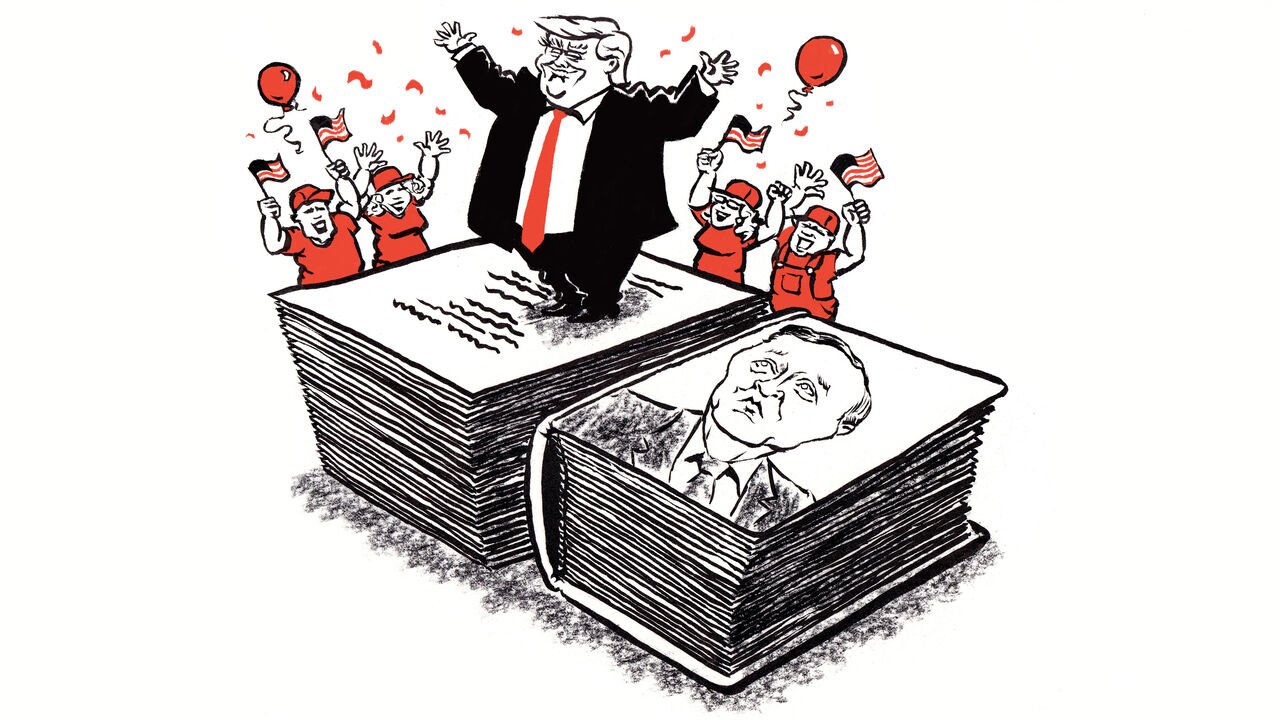
FOR ALL the thunderbolts Donald Trump let fly to frighten Republicans into blessing his gassy tax-and-spending bill, his most illuminating gesture in the months-long drama was also his most timid. In May the president meekly posted on social media that he “and all others” would “graciously accept” a tax increase on the rich. Republicans should “probably not do it”, he added, passive-aggressively, “but I’m OK if they do!!!”
Mr Trump wrote that Republicans were wrong to fear that Democrats would gain from accusing them of breaking a promise not to raise taxes. He clearly saw that raising taxes on the rich would instead make sense to his MAGA masses and also strip Democrats of one of their few remaining salient attacks. As he told Time magazine in an interview earlier this year, if he raised taxes on millionaires, he would be taxing the wealthy “to take care of the middle class”. He added, “I love that.”
Mr Trump’s populist politics, and the contortions they create for his party, are often treated as a new phenomenon in American politics. In fact, they are the latest expression of a decades-old identity crisis. That becomes clear when Mr Trump’s “One Big Beautiful Bill Act” is considered alongside this summer’s other monumental new text, also of about 1,000 pages but of wildly superior quality: “Buckley: The Life and the Revolution that Changed America”, a biography of the conservative crusader William F. Buckley by Sam Tanenhaus. As far back as the 1960s, well before Buckley helped elect Ronald Reagan as the embodiment of his anti-statist, low-tax vision, he was struggling with how to reconcile those positions with the class politics, and dependence on government programmes, of the voters emerging as the Republicans’ core constituency: the “forgotten Americans”, a term, like so much else, that Mr Trump has lifted from politics past.
The Republicans are now in the grip of an ego more super even than Buckley’s. But the party’s id remains Reaganesque, as demonstrated by Mr Trump’s timidity about tax increases, his regressive tax cuts, and his breezy assurances that growth will cover their debt-defying cost. But while orthodox Republicans under Reagan tried to simplify the tax code, dangling before forgotten Americans the hope they might get rich someday, Mr Trump’s populists have cluttered the code with breaks for favoured constituencies such as workers who depend on tips.
Never-Trump conservatives who see themselves as Buckley’s heirs may bridle at the observation, but though Buckley was no populist, he augured Mr Trump. Not really a journalist or theorist, Buckley was a “performing ideologue”, Mr Tanenhaus writes, early to recognise “that politics was becoming a large public spectacle”. His only fear was being bored, and he had an instrumental approach to fact. He applauded bullies such as the red-baiting Senator Joe McCarthy when they were on his side. In the biography the single mention of Mr Trump is telling: he and Buckley both gave testimony on behalf of Roy Cohn, the ravening lawyer who was McCarthy’s chief counsel, when he unsuccessfully fought disbarment for grievous misconduct.
Like Mr Trump, Buckley was a fierce culture warrior, and to his last days he saw campuses as the most important ideological battlefields. It seemed to be a joke when Buckley ran for mayor of New York in 1965 as the Conservative candidate, to steal votes from a liberal Republican. But his celebrity, sophistication about television, and willingness to say just what he thought made him popular as a kind of anti-politician. His fulmination about crime and esteem for the police drew support from Democrats as well as Republicans. He came in third, but no less a light than Richard Nixon saw him as a grave threat who could shift the party radically to the right. Over the next decade Buckley did just that.
The book of theory Buckley never managed to write was to be called “The Revolt against the Masses”, and for years he favoured denying black Americans, among others, the vote. His discomfort with democracy made a poor match with populism. Moreover, although the cultural elite never embraced Mr Trump the populist (“I’ll never have the goodwill of the establishment, the tastemakers of New York,” he groused back in his days as a developer) they toasted Buckley the conservative. His books were serialised in the New Yorker and he had his own show, “Firing Line”, on public television, of all places. Of 1,505 episodes, his proudest was in 1978, when he debated Reagan over the Panama Canal treaty. Reagan, with his populist instincts, opposed it for the same reasons Mr Trump would one day demand the canal back. But Buckley, magisterially, wanted to know if America would take human rights and sovereignty seriously, or be distracted by “the irrelevance of prideful exercises, suitable rather to the peacock than to the lion”.
That is what most separates the old Buckley conservatives from the new Trumpist populists. In his heyday Buckley had a great cause, opposing communism. Anti-statism and free-market economics rhymed with that purpose. While the collapse of the Soviet Union was good for humanity, it was terrible for the coherence of American politics. Like tax cuts for the rich, free-market principles linger in Mr Trump’s party mostly as muscle memory.
The president calls himself a conservative, but taxes trade on a whim and requires businesses and universities to conform to his politics. He has seized a “golden share” in US Steel that gives him authority over its means of production. Yet, because the old labels have an atavistic power, he delights in calling the new Democratic nominee for mayor of New York “a pure, true communist”, though he is really just the latest social-media avatar of the other party, which has forgotten history, lost its grasp on the present, and chosen to dwell in a utopian future. But that is another column. ■